
Havening Techniques®
What is Havening?
The short answer is that it is a hands-on practice using light touch on the arms, hands and face, alongside some guided attention. You stay awake and in control the whole way through.
The longer answer is below, including the parts people do not usually put on their websites.
Where it came from
Havening was developed by Dr Ronald Ruden, a medical doctor in New York, along with his brother Dr Steven Ruden. The name comes from the word haven, in the sense of a refuge.
It has been taught to practitioners around the world since the early 2010s. I trained in October 2025, certified in April 2026, and I use it exclusively in my practice.
What the touch is
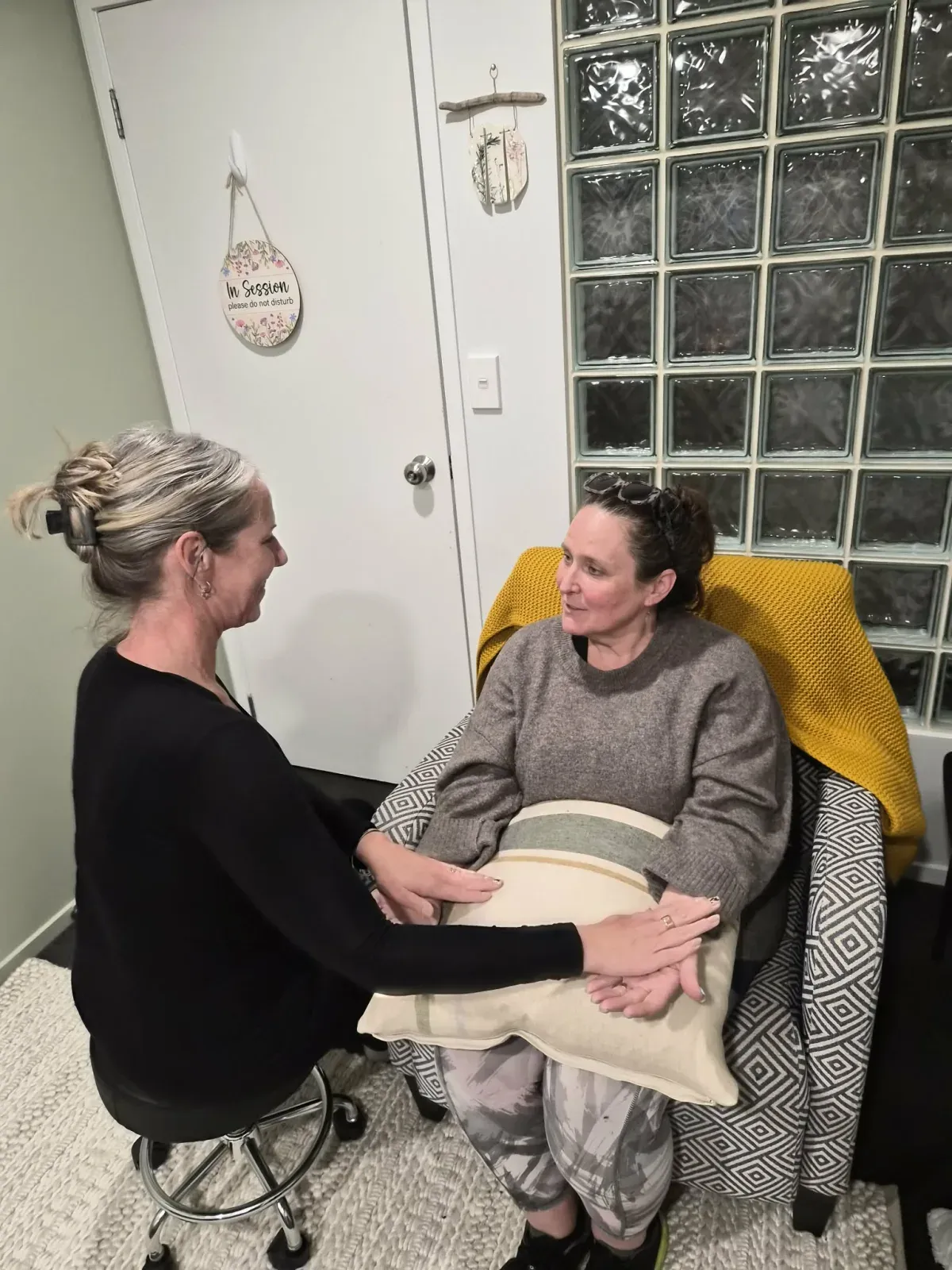
Slow, light stroking down the upper arms, across the palms of the hands, and over the forehead. That is genuinely all it is. No pressure, and nothing that hurts.
I will show you before we start. Some people prefer to apply the touch themselves, and that works just as well. You do not need to give me a reason either way.
Whose work it is
Worth saying early, because it changes how the whole thing feels. I am guiding. You are doing the work, and the shifts happen in your own body. I am not the expert on you, and I am not going to behave as though I am. You are the expert on you.
Which is also why we start with connection. Establishing safety and trust between us is what the first part of a session is for, and it is where resilience gets built. It is part of the work rather than the run-up to it.
The idea behind it
It starts with the amygdala, the brain's warning system. Its job is to spot danger fast and get you out of the way of it, and it works far quicker than the thinking part of you does. When something overwhelming happens, as the model describes, that experience gets stored as a threat rather than filed away as an ordinary memory. The warning system keeps it live and on the alert list. That is why a smell, a tone of voice or a time of year can put your body straight back into it years later, long after you have made sense of the whole thing in your head.
Havening's model proposes that this particular kind of touch, paired with where you put your attention, changes the electrical activity in the brain and lets that encoding come undone. Havening calls it de-encoding or depotentiating the memory.
In slightly more detail, and you are welcome to skip this part. The model holds that gentle stroking of the arms, hands and face generates delta waves, the slow brainwaves seen in deep sleep. The proposal is then that if a distressing memory is held in attention while the brain is in that state, the delta wave activity interferes with the receptors that keep that memory on the warning list. The claim is not that the memory goes anywhere. The memory stays. What is said to change is the emotional charge it carries.
The model also describes the touch as prompting a shift in the brain's own chemistry, with an increase in:
- Serotonin, associated with mood and feeling good
- Oxytocin, associated with bonding, safety and connection
- GABA, the brain's main calming signal, associated with reduced anxiety
And a lowering in cortisol, the stress hormone.
Sitting underneath all of that is neuroplasticity, and that part is not in dispute at all. The brain was once thought to be more or less fixed by adulthood. It is not. It goes on forming and reshaping connections for the whole of your life, which is simply to say that things are not set in stone.
If you would rather watch someone explain it than read it, Tam Johnston's What is Havening and how does it work? is the clearest version of it I have found. There is a shorter, gentler one on the resources page too, if the science is not what you are after.
I am guiding. You are the one doing the work.
Fast for some, slow for most
There is no standard timeline here, and what people describe varies a great deal.
For some, something shifts in the room. They walk out saying it was immediate, and they describe it as life changing. That happens, and it is lovely when it does.
For most people it is slower and quieter than that. Nothing announces itself. Then at some point you look back over the past few months and notice that something you used to brace for does not land the way it used to.
Mine was the slow kind, and it was still life changing for me. So a quiet session is not a failed one.
What I can tell you is what I have seen. Every client I have worked with has left calmer than when they arrived. Most, within a few days, have given themselves some compassion and the space they needed to process things and move through what felt stuck. That is what I have seen so far, rather than a promise about what you will get.
What it is not
- It is not hypnosis.
- You stay fully awake and aware. You are not in a trance and you are not suggestible.
- It is not massage.
- The touch is light and specific, and it is not about muscles.
- It is not counselling.
- I am not a registered health practitioner — not a psychologist, psychotherapist or counsellor — and Havening is not talk therapy. You will not be asked to talk about anything you are not comfortable with. You are very welcome to share your experiences, feelings and thoughts though, and there is no judgement from me if you do.
- It is not a replacement for medical care.
- If you are under a doctor or a mental health professional, stay with them. Havening sits alongside that, not instead of it.